Invited Speakers & Panelists
Speakers & Panelists
(more to come soon)

Professor of ECE · University of Texas at Austin
David Z. Pan is the Silicon Labs Endowed Chair Professor at the Department of Electrical and Computer Engineering, The University of Texas at Austin. His research interests include design automation for digital/FPGA, analog/mixed-signal and RF ICs, and advanced packaging, synergistic AI/IC co-optimizations, and design/system and technology co-optimization. He has published over 550 technical papers and 10 US patents. He has served in many editorial boards and conference committees, including General Chair of DAC 2027 and ICCAD 2019. He has received many awards, including SRC Technical Excellence Award, Nvidia Research Faculty Fellow, MediaTek Academia-Industry Collaboration Excellent Research Award, UCLA Samueli Professional Achievement in Academia Award, and over 20 Best Paper Awards from premier EDA/chip/AI venues, among others. He has graduated over 60 PhD students and postdocs who are now holding key academic and industry positions. He is a Fellow of IEEE, ACM, and SPIE.

Professor of ECE · Princeton University
Dr. Sengupta is an IEEE Fellow and currently Professor in the department of Electrical and Computer Engineering at Princeton University. His group invented generative AI and reinforcement-learning based end-to-end RFIC design. He received a B.Tech/M.Tech (dual degree) in Electronics and Electrical Communication Eng. from the IIT Kharagpur, in 2007, and a Ph.D. in Electrical Engineering from Caltech in 2012. He received the DARPA Young Faculty Award in 2018, the Bell Labs Prize in 2017, the Young Investigator Program Award from the Office of Naval Research in 2017, the Prime Minister Gold Medal Award from IIT Kharagpur in 2007, the Charles Wilts Prize at Caltech for the best Electrical Engineering Ph.D. thesis in 2013, and the inaugural Young Alumni Achievement Award from IIT Kharagpur in 2018. He served as a Distinguished Lecturer for the IEEE Solid-State Circuits Society from 2019 to 2020 and for the IEEE Microwave Theory and Technology Society from 2021 to 2023. He is a recipient of the 2021 IEEE Microwave Theory and Technology Outstanding Young Engineer Award and the 2022 IEEE Solid-state Circuits New Frontier Award. He received the IEEE Microwave Prize in 2015, several best paper awards including IEEE IMS (2020, 2021, 2022, 2025), RFIC (2012), and the Best paper of the year award from IEEE Journal of Solid-State Circuits in 2023 for the first deep-learning enabled RFIC design. He has over 20+ patents, and his work led to the start-up on long-distance wireless power transmission called Guru Inc, based in California, in which he has served as an advisor.
Dean's Professor of ECE & CS · University of Southern California
Co-Founder · Teamily AI
Co-Founder · Teamily AI
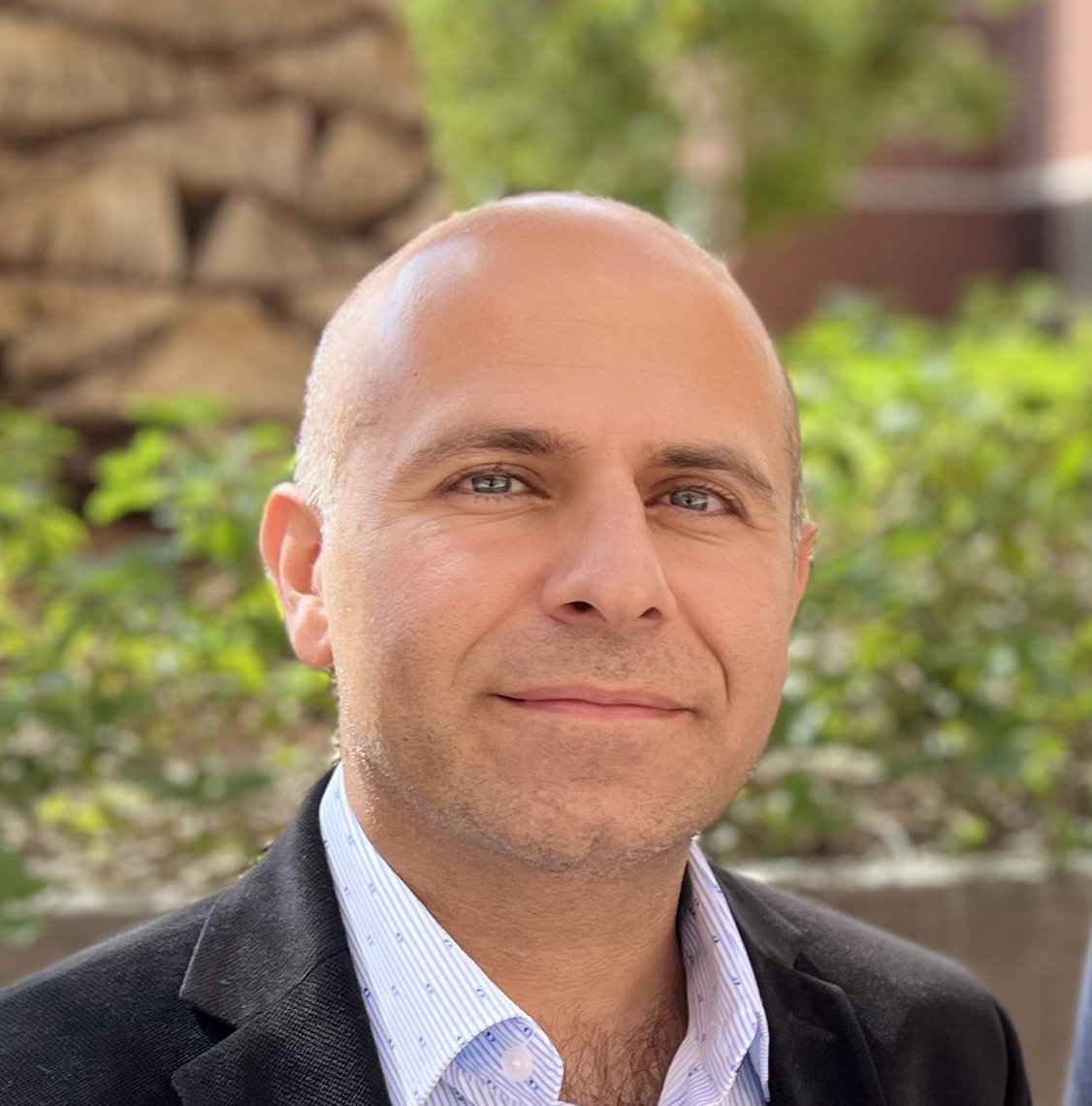
Salman Avestimehr is a Dean's Professor of Electrical and Computer Engineering and Computer Science at the University of Southern California, where he serves as the inaugural Director of the USC-Amazon Center on Trustworthy AI. He is also Founding Co-Director of Falcon AI Lab, a collaborative research hub between USC, UCI, and Stanford University for AI-driven chip and analog circuit design.
He is also a serial entrepreneur and co-founder of several leading AI initiatives, including FedML (a widely adopted open-source library for federated machine learning); TensorOpera AI (a full-stack agentic AI platform); ChainOpera AI (a decentralized AI infrastructure platform); and Teamily AI (a human-AI social platform for collaborative intelligence).
Dr. Avestimehr received his Ph.D. (2008) and M.S. (2005) in Electrical Engineering and Computer Science from the University of California, Berkeley. His research focuses on information theory, distributed and federated machine learning, and trustworthy AI systems. His work has received numerous prestigious recognitions, including the Presidential Early Career Award for Scientists and Engineers (PECASE), the James L. Massey Research & Teaching Award from the IEEE Information Theory Society, a Joint Paper Award from the IEEE Information Theory and Communication Societies, and a Young Investigator Program award from the U.S. Air Force Office of Scientific Research. He is also a recipient of the National Science Foundation CAREER Award, the David J. Sakrison Memorial Prize, and multiple best paper awards at leading conferences. Dr. Avestimehr is an IEEE Fellow.


Professor of ECE · University of Hawaiʻi at Mānoa
Boris Murmann is a Professor of Electrical & Computer Engineering at the University of Hawaiʻi, Mānoa. From 2004-2023 he was a Professor of Electrical Engineering at Stanford University. Since 2004, Dr. Murmann has worked as a consultant with numerous Silicon Valley companies and he currently serves as the Chief Scientist of Omni Design Technologies, San Jose, CA. His research interests are in the area of mixed-signal integrated circuit design, including sensor interfaces, A/D and D/A conversion, high-speed communication links, embedded machine learning (tinyML), design methodology, as well as open-source chip design. He is a Fellow of the IEEE and currently serves as the Editor-in-Chief of the IEEE Journal of Solid-State Circuits.

Co-Founder & CTO ·
Cognichip Inc.
Ehsan is the co-founder and CTO of Cognichip, leading the development of physics-informed foundational models for computer chip design. His career spans both academia and industry: he earned a PhD in Applied Mathematics from the University of Toronto, conducted postdoctoral research in Machine Learning at UCLA/UCR, and served as an Associate Professor at California State University, East Bay.
At Apple, Ehsan led several computer vision and natural language processing initiatives, contributing notably to the Memories feature in Apple Photos used by millions worldwide. Later, as a Tech Lead at AWS, he pioneered the company's first Reinforcement Learning from Human Feedback (RLHF) pipeline, where his work was adopted by numerous client companies and presented at major industry events, including the AWS Summit and AWS re:Invent.
At Apple, Ehsan led several computer vision and natural language processing initiatives, contributing notably to the Memories feature in Apple Photos used by millions worldwide. Later, as a Tech Lead at AWS, he pioneered the company's first Reinforcement Learning from Human Feedback (RLHF) pipeline, where his work was adopted by numerous client companies and presented at major industry events, including the AWS Summit and AWS re:Invent.

Associate Professor & Colleen and Roberto Padovani Early Career Chair of ECE · University of Southern California

Chancellor's Professor & Henry Samueli Faculty Excellence Professor of EECS & BME · University of California, Irvine

Postdoctoral Researcher of EECS · University of California, Berkeley

Chief Scientist & IBM Fellow · IBM Research
Dr. Ruchir Puri is the Chief Scientist of IBM Research, and an IBM Fellow, and Vice-President of IBM Technology. He led IBM Watson as its CTO and Chief Architect from 2016-19 and has held various technical, research, and engineering leadership roles across IBM's AI and Research businesses. Dr. Puri is a Fellow of the IEEE, and has been an ACM Distinguished Speaker, an IEEE Distinguished Lecturer, and was awarded 2014 Asian American Engineer of the Year. Ruchir has been an adjunct professor at Columbia University, NY, and a visiting scientist at Stanford University, CA, is the recipient of the Distinguished Alumnus Award from Indian Institute of Technology (IIT), Kanpur. He was honored with John Von-Neumann Chair at Institute of Discrete Mathematics at Bonn University, Germany. He is an inventor of over 75 US patents and has authored over 150 scientific papers.
Fellow & VP of R&D · Synopsys